Tuesday, November 2, 2010

1864 Election Night - Notre Dame Style!

Tonight, November 2, 2010, is a mid-term election night, and (hopefully) readers of this blog will have voted today and many may be watching the returns tonight. You think today's politics are tough?! Wait until you read how the votes at Notre Dame almost ruined election night for the Speaker of the House in 1864!

Read part of the story below and read the entire tale in Notre Dame and the Civil War: Marching Onward to Victory (The History Press, 2010), available in just a few weeks!

In the midterm elections of 1862 – a tough proposition for the party in power – South Bend, Indiana's representative, Republican Schuyler Colfax, had faced stiff competition from Democrat “Dirty Dave” Turpie and won the election by a slim margin of less than 300 votes. In 1864, even as the powerful Speaker of the House, Colfax faced another difficult election at home. The voting public’s anxiety over wartime inflation and a burgeoning fifth column of Copperheads in Indiana compelled Colfax to write Lincoln, “the odds are heavy against us in Indiana.” Colfax would again face Turpie, who was still stinging from his close defeat in 1862 which the Democrats attributed to “fraud and trickery.” So motivated was Turpie to “lay Schuyler Colfax upon the shelf” that he turned down his party’s nomination as lieutenant governor.

On the eve of the election, the generally politically astute Notre Dame president, Fr. Sorin, wrote a friend that Colfax was devoted to him and that he (Sorin) sometimes availed myself of this good will. Fr. Sorin boasted of the power he had, writing that Colfax knew he had at his disposal from sixty to seventy-five votes at Notre Dame each election, either for him or against him. Colfax, who had always counted on those votes from Notre Dame, needed them in 1864. To that end, he visited Fr. Sorin to express his anxiety over the political landscape and reminded the good father of the draft exemptions and other political favors the Republican Party had secured for him.

Fr. Sorin understood Colfax’s not-so-subtle intimations and called a meeting of the priests and brothers that lasted for several hours and resulted in a resolution which was calculated to have the best result: that is, that no other ticket than the Republican or Union ticket shall be voted by the members of the Holy Cross congregation. Unfortunately, the person responsible for passing on this important information to the other members of the Notre Dame community failed to carry out this critical assignment, and the result was that - as Fr. Sorin reported to his superior – “three-fourths…voted against [Colfax]." (!)

Why did the priests and brothers vote against Colfax?
Did Colfax win?
How did Colfax retaliate against Notre Dame?
How did a thousand Haily Mary's (and a famous general's wife!) save the day?
Did Fr. Sorin (and Schuyler Colfax) learn a lesson?


Find out by reading Notre Dame and the Civil War: Marching Onward to Victory (The History Press, 2010), available November 24!

Friday, October 29, 2010

"Fair Catch Corby" - Part II - 1910 Dedication

As mentioned in my previous post, today - October 29, 2010 - marks the centennial of the original dedication ceremony of the Fr. Corby statue at Gettysburg. The previous post described the fundraising efforts for the statue. Today's post will describe the crafting of the statue and newspaper coverage of the 1910 dedication.

You will learn much more about Fr. Corby and the statue in my forthcoming book, Notre Dame and the Civil War: Marching Onward to Victory (The History Press, Dec 2010).

The statue committee commissioned Samuel Aloysius Murray to craft the statue. A native of Philadelphia, Murray began his artistic studies at the ageof seventeen under the tutelage of the renowned American painter and sculptor Thomas Eakins. Murray was an ideal choice for the Father Corby statue: he had strong ties to Philadelphia’s Irish Catholic community,and by the turn of the century he had become one of America’s mostpromising artisans. His works won recognition at expositions in America and in Europe and are prominent in Philadelphia and Washington,D.C. His most ambitious piece, the Goddess of Victory and Peace atop the Pennsylvania State Memorial, shares the Gettysburg battlefield with his statue of Father Corby.

In 1910, Murray proceeded quickly with the model and with the final casting. The unveiling was scheduled for later in the year, but unfortunately the statue’s greatest patron did not live to see the day: General St. Clair Mulholland died on February 17, 1910. He literally worked on the statue until the day he passed, so concerned was he that his cherished project would fail. Henry A. Daily, a member of the statue commitee, remembered:

“a few hours before [Mulholland] died, he sent for me and I then assured him that the monument need give him no concernas I felt that the erection of the monument…was as certain as if the statuewas at that time in place.”

Trains began arriving in Gettysburg on Friday, October 28, 1910. That evening a “camp fire” was held in a town hall, where children from the local Catholic school sang songs such as “Tenting Tonight on the Old Camp Ground” and dignitaries such as University of Notre Dame president Father John Cavanaugh delivered speeches. By one o’clock onSaturday afternoon, as church bells rang, hundreds more visitors had arrived by train and had begun assembling on the battlefield (on Hancock Avenue) for the ceremony. Walter George Smith, a noted Philadelphia lawyer and master of ceremonies, declared:

We are assembled to commemorate an event unique in the history of the great Civil War…The pages of history glow with the records of deeds and heroism done on land and sea by officers, soldiers and sailors, who illustrated courage on both sides of the mighty conflict, and with fitting appreciation…the scenes they have immortalized have been marked by grateful people, but now for the first time a monument has been erected to perpetuate the memory of a deed done directly for the glory of God and the salvation of the human soul. Amid these triumphant monuments of soldiers we have placed the presentment of a priest…performing one of the most sacred functions of his office…We may hope that it will bring to the minds of every traveler upon this field for generations yet unborn…the name and deed of the heroic Chaplain.

After additional speeches and a benediction, a young girl pulled a flag covering the bronze statue of Father Corby, hat and gloves at his feet, left hand over his heart and his right arm raised in absolution. “There was no attempt at ostentation or display,” a local newspaper reported, “but as the folds of the Stars and Stripes dropped and revealed the figure ofthe revered father…the entire audience stood for a moment of silence in token of their regard, esteem and respect for the man whose memorywas so fittingly honored today.”


Monday, October 25, 2010

"Fair Catch Corby" - Part I - Raising the Dough

Few of the seven Holy Cross priests that Notre Dame sent to serve as chaplains in the Civil War have received as much attention as Fr. William Corby. Indeed, few chaplains in all the war have received as much attention as Fr. Corby. He has been immortalized in poetry, paint, and even in modern film (Gettysburg), but the most enduring image is that of the statue of Fr. Corby on the battlefield of Gettysburg and the replica at the University of Notre Dame, which has earned the nickname, "Fair Catch Corby."

Readers of my forthcoming book, Notre Dame and the Civil War:Marching Onward to Victory (The History Press, 2010) will learn much about Fr. Corby and about the statue, but I wanted to share some information now as this is a very special week:

Friday, October 29, 2010, marks the centennial of the original dedication ceremony of the Fr. Corby statue at Gettysburg (the replica at Notre Dame was dedicated on Memorial Day, 1911).

Of course, before the statue could be crafted and erected, money had to be raised. Below, you will find images of the c. 1909 fund-raising pamphlet - "Father Corby at Gettysburg" - an original of which I'm proud to have in my collection.

Enjoy!

Later this week, I'll share newspaper clippings from the original dedication ceremony!


Wednesday, October 20, 2010

Judging a Book By Its Cover

Hey, I know you aren't supposed to judge a book by its cover, but don't you think this is a pretty good start?

THANKS SO MUCH to th
e great folks at The History Press for the hard work they put into crafting this lovely cover! Please let me know what you think!

We're almost there - we are shooting for a first-week-of-December publication date!


Stay tuned to this blog for details!


Thursday, September 16, 2010

Jim Channels Winona (Channeling Jo)

At the risk of losing my "man card" I have to confess that one of my favorite films is "Little Women" (1994) and one of my favorite scenes is towards the end, when "Jo" (aka Winona Ryder...sigh) has finished her manuscript...ties it up in a bow...bites her nails...and prepares to send it off.

I can empathize with her...especially the nail-biting part: today I am sending my manuscript for Notre Dame in the Civil War: Marching Onward to Victory to the publisher (The History Press). It's done!

Stay tuned here on the "Notre Dame in the Civil War" blog for additional details and production schedule. I'll also be updating this blog more frequently with highlights from the book and extra material and research!

I expect to see a draft of the cover art in a week or so! Exciting!

The book is scheduled to be available late this year (hopefully in time for the holidays!) or early 2011. Thanks for all the support!

(Cross-posted from Civil War Medicine andWriting)

Tuesday, August 24, 2010

Chained to the Desk!

...Well, it's not quite that bad. I know I haven't posted here in 6 or so weeks but there's a good reason: I've been working hard on the manuscript for Notre Dame in the Civil War (The History Press, 2010/2011)! The manuscript is due in mid-September, which isn't far off, so I am finishing the writing and polishing what's already done.

There has been progress, though! The illustrations were due in mid-August and I have already turned those in. The History Press does a terrific job of incorporating a good amount of illustration material in all their books and this one will be no different! I sent them thirty photographs, etc., and I am confident that 20-25 of those will enliven the pages of the narrative!

With the illustration material in the hands of The History Press, it also means their artists are working on a nifty cover! I can't wait to see what they come up with (they have some great people there!) and you can be sure I will be sharing the cover art here on the blog as soon as I have it!

When the book is done and ready to go to press in the next several weeks you can also be assured I will return to blogging here in earnest...there is so much to tell about Notre Dame's epic Civil War story!

Stay Tuned!

Tuesday, July 6, 2010

Notre Dame in the Civil War Photo Contest Winners!

Thanks to everyone who responded to my call for photographs in the "Notre Dame in the Civil War" photo contests!
I am pleased to announce the winners!
Michael Aubrecht - Fr. Corby Statue - Gettysburg
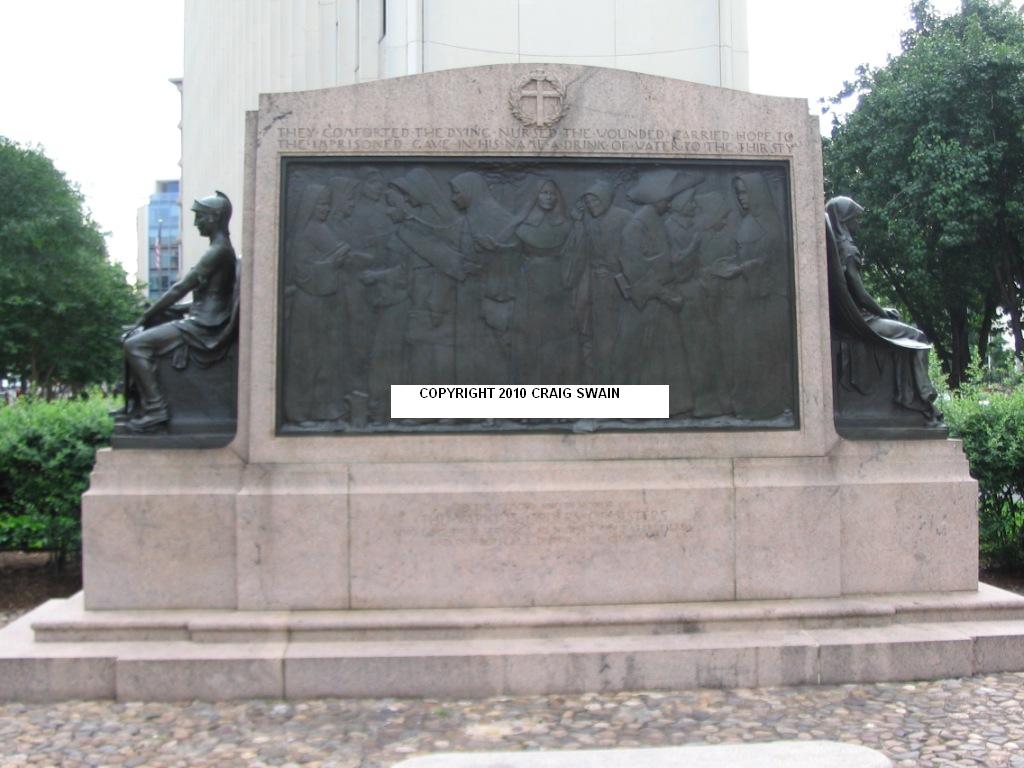
Craig Swain - "Nuns of the Battlefield Monument - Washington, DC
Corrine Rypka - Civil War Soldier and Sailor Monument - Elkhart, IN

They are wonderful photographs! All three photographers will get a free copy of Notre Dame in the Civil War (The History Press) when it is published. If the publisher agrees, these photographs will also appear in the book! Congratulations to Michael, Craig, and Corrine!

I have provided them below (note they are "masked" with text to protect their work and prevent unauthorized use).